Artificial intelligence is rapidly moving from isolated pilot projects to a core component of enterprise strategy. Organizations across industries are leveraging AI to automate processes, improve customer experiences, accelerate decision-making, optimize operations, and unlock new business opportunities. However, achieving long-term success with AI requires more than deploying models or adopting the latest technologies.
Many enterprises discover that their existing technology environments were not designed to support the scale, complexity, and data demands of modern AI workloads. Legacy systems, fragmented data sources, inconsistent governance practices, and infrastructure limitations often become barriers to AI adoption and growth.
This is why organizations are increasingly focusing on building AI-ready enterprise architectures.
An AI-ready architecture provides the technological and operational foundation needed to support current AI initiatives while remaining flexible enough to accommodate future innovation. It enables organizations to scale AI capabilities efficiently, maintain governance and security, optimize costs, and ensure that AI investments deliver measurable business value.
What Is an AI-Ready Enterprise Architecture?
An AI-ready enterprise architecture is a technology framework designed to support the development, deployment, management, and scaling of AI applications across the organization.
Unlike traditional architectures that primarily focus on application delivery and infrastructure management, AI-ready environments must accommodate the unique requirements of data-intensive workloads, machine learning systems, generative AI applications, and intelligent automation platforms.
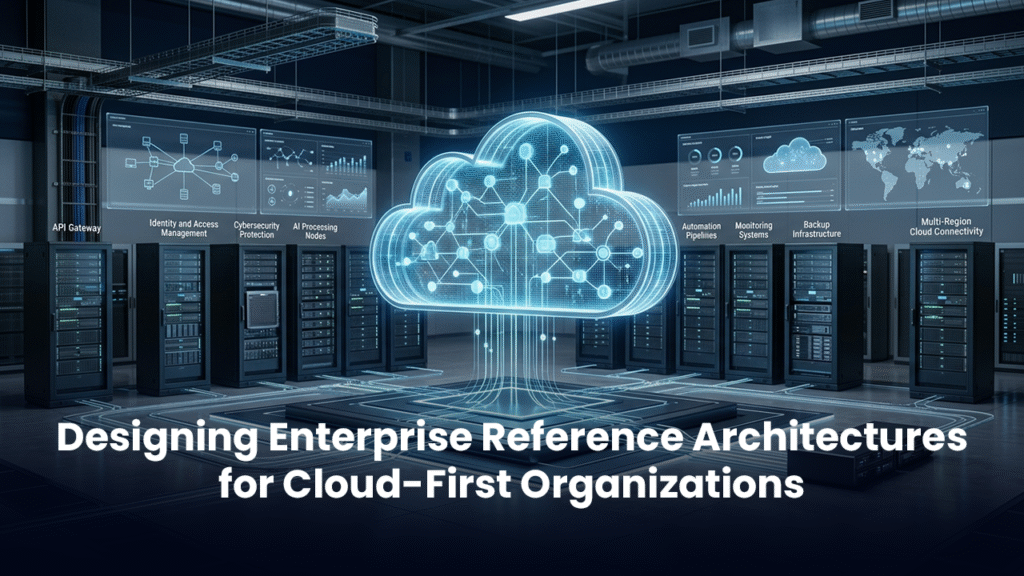
An effective AI-ready architecture typically includes:
- Scalable cloud infrastructure
- Unified data platforms
- AI and machine learning services
- Security and governance controls
- Observability and monitoring capabilities
- Automation frameworks
- Integration and API management layers
These components work together to create a resilient environment capable of supporting enterprise-wide AI adoption.
Why Traditional Architectures Struggle with AI
Many existing enterprise environments were designed before AI became a strategic priority.
Traditional architectures often face challenges such as:
- Data silos across departments
- Limited scalability for compute-intensive workloads
- Inconsistent data governance
- Legacy application dependencies
- Fragmented security controls
- Insufficient visibility into operational performance
These limitations can slow AI projects, increase operational costs, and reduce the effectiveness of AI initiatives.
For example, an organization may have access to valuable business data, but if that information is distributed across disconnected systems, AI models may struggle to access the data required for training or inference.
Similarly, legacy infrastructure may be unable to support the computational demands of modern AI workloads, particularly those involving large language models, advanced analytics, or real-time processing.
Building a Strong Data Foundation
Data is the fuel that powers AI systems.
Without high-quality, accessible, and well-governed data, even the most sophisticated AI models will struggle to deliver meaningful results.
An AI-ready architecture should prioritize:
- Data integration across systems
- Consistent data quality standards
- Metadata management
- Data lineage tracking
- Governance and compliance controls
- Scalable storage environments
Organizations should focus on creating unified data ecosystems that eliminate silos and enable secure access to trusted information.
By improving data accessibility and governance, enterprises can accelerate AI development while reducing operational complexity.
Leveraging Scalable Cloud Infrastructure
AI workloads often require significantly more computing power than traditional business applications.
Training machine learning models, running large language models, processing real-time analytics, and supporting generative AI applications can place substantial demands on infrastructure.
Cloud platforms provide the flexibility and scalability needed to support these workloads.
An AI-ready architecture should incorporate cloud capabilities such as:
- Elastic compute resources
- GPU-enabled environments
- High-performance storage
- Distributed processing frameworks
- Automated infrastructure provisioning
Scalable cloud infrastructure enables organizations to respond quickly to changing business requirements while optimizing resource utilization.
It also helps reduce the need for large upfront infrastructure investments.
Designing for Integration and Interoperability
Enterprise AI systems rarely operate in isolation.
They typically interact with business applications, data platforms, customer systems, external services, and cloud environments.
As AI adoption expands, seamless integration becomes increasingly important.
Organizations should establish architecture patterns that support:
- API-driven connectivity
- Microservices-based design
- Event-driven workflows
- Hybrid and multi-cloud environments
- Third-party AI services
Strong integration capabilities help ensure that AI solutions can be embedded into existing business processes without creating additional complexity.
Interoperability also improves flexibility as technologies and business requirements evolve.
Embedding Security into the Architecture
AI systems often process sensitive business information, customer data, financial records, and intellectual property.
As a result, security must be integrated into every layer of the architecture.
An AI-ready security framework should address:
- Identity and access management
- Data encryption
- API security
- Network protection
- Threat detection
- Compliance monitoring
Organizations should adopt security practices that align with modern cloud and AI environments, including zero-trust principles and continuous verification models.
Embedding security early reduces risk while supporting responsible AI adoption.
Establishing Governance for AI at Scale
As AI initiatives grow, governance becomes increasingly important.
Without clear policies and accountability, organizations may struggle to manage risks related to data usage, model behavior, regulatory compliance, and operational oversight.
An AI-ready architecture should support governance through:
- Data management policies
- Model lifecycle controls
- Audit logging
- Compliance frameworks
- Risk management processes
- Access controls
Governance helps ensure that AI systems remain transparent, accountable, and aligned with organizational objectives.
It also supports evolving regulatory requirements and industry standards.
Prioritizing Observability and Monitoring
Visibility is essential for maintaining reliable AI operations.
Traditional monitoring tools often focus on infrastructure and application performance but may not provide insights into AI-specific metrics.
An AI-ready architecture should include observability capabilities that monitor:
- Infrastructure utilization
- Model performance
- Data quality
- API activity
- Inference latency
- Resource consumption
- Cost trends
Comprehensive observability helps organizations identify issues quickly, optimize performance, and improve operational decision-making.
As AI environments become more complex, monitoring capabilities become increasingly valuable.
Incorporating Automation Across Operations
Manual processes can quickly become bottlenecks as AI initiatives scale.
Automation enables organizations to improve efficiency, reduce errors, and accelerate innovation.
Key areas for automation include:
- Infrastructure provisioning
- Data pipeline management
- Model deployment workflows
- Security enforcement
- Compliance validation
- Resource optimization
Automation not only improves operational consistency but also frees technical teams to focus on higher-value strategic activities.
A mature automation strategy is often a hallmark of successful AI-ready architectures.
Supporting AI Model Lifecycle Management
Enterprise AI environments may involve dozens or even hundreds of models operating across various business functions.
Managing these models effectively requires structured lifecycle processes.
Organizations should establish frameworks for:
- Model development
- Validation and testing
- Deployment management
- Version control
- Performance monitoring
- Retirement planning
Lifecycle management helps ensure that AI systems remain accurate, secure, and aligned with business objectives over time.
It also reduces the risks associated with uncontrolled model sprawl.
Preparing for Future Growth
One of the defining characteristics of an AI-ready architecture is adaptability.
The pace of innovation in AI continues to accelerate, and organizations must be prepared to integrate new technologies, workloads, and business requirements.
Future-ready architectures should emphasize:
- Modularity
- Scalability
- Flexibility
- Standardization
- Interoperability
These principles enable organizations to evolve their AI capabilities without requiring extensive redesigns or disruptive infrastructure changes.
By planning for growth from the outset, enterprises can maximize the long-term value of their AI investments.
Aligning Architecture with Business Objectives
Technology decisions should always support business outcomes.
An AI-ready architecture is not simply about deploying advanced infrastructure or adopting emerging technologies. It is about creating an environment that enables organizations to achieve strategic goals more effectively.
Successful architectures align technical capabilities with priorities such as:
- Operational efficiency
- Customer experience improvement
- Revenue growth
- Risk reduction
- Innovation acceleration
Maintaining this alignment helps ensure that AI initiatives generate measurable value rather than becoming isolated technology projects.
Conclusion
As AI becomes a central component of enterprise strategy, organizations must rethink how their technology environments are designed and managed. Traditional architectures often lack the scalability, flexibility, governance, and observability required to support modern AI workloads.
An AI-ready enterprise architecture provides the foundation for sustainable growth by integrating scalable cloud infrastructure, unified data platforms, strong security controls, governance frameworks, automation capabilities, and operational visibility.
Organizations that invest in building AI-ready environments today will be better positioned to scale innovation, optimize performance, manage risks, and adapt to future technological advancements.
In an increasingly AI-driven world, architecture is no longer just an IT concern—it is a strategic enabler of long-term business success.